

For a while, following a routine seemed sufficient. The change was not immediate. It was quieter… and harder to attribute.
By Ehab Soltan
HoyLunes — There was a time, not long ago, when the reflection did not generate doubts. We applied a cream, the skin responded, and the mirror confirmed that everything remained in order. There were no questions.
With time, something changes. Not abruptly, but with an almost imperceptible persistence. The skin no longer responds the same way. And the mirror, which once confirmed, begins to reveal.
For years, skin care became a matter of adding. More steps, more formulas, more precision. And for a while, it worked.
Until it stopped working the same way.
Not because something obvious was missing.
But because something had begun to accumulate.
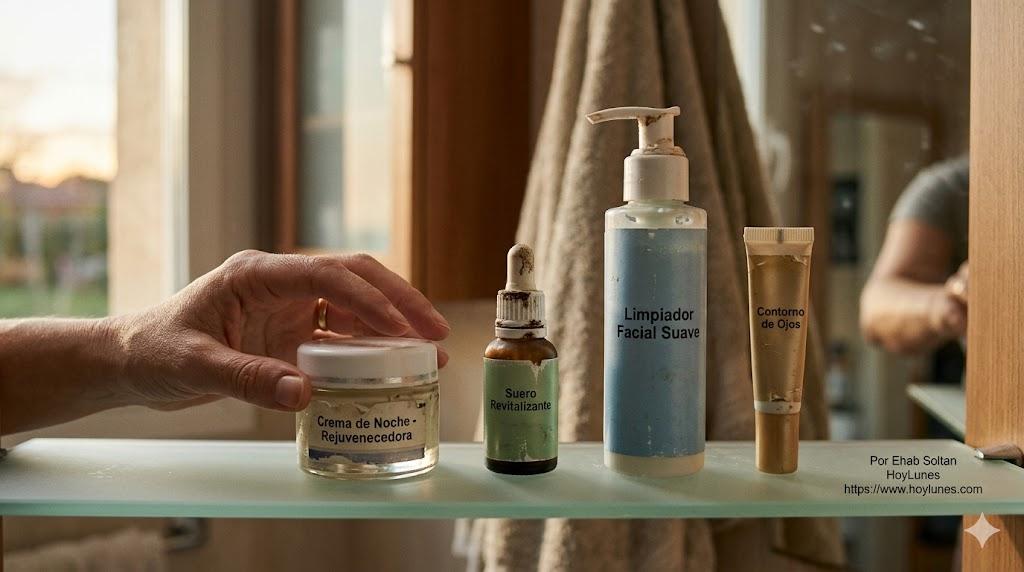
The Mirage of the Perpetual Routine
Let us take the case of a 38-year-old woman, whose experience is easily recognizable. For more than five years, her ritual was constant: gentle cleansing, hydration, and sporadic sun protection. There were no excesses, just a constancy that seemed sufficient. Her life took place in an office, with a reasonable diet and acceptable sleep. Her skin was stable, a canvas that caused no problems.
However, in recent months, the mirror began to return a different image: not a deep wrinkle, but a subtle loss of luminosity, a feeling of fatigue settled in the expression, a texture that was no longer the same. She had not stopped taking care of herself; it is that her skin had stopped reacting to a repetition that, on its own, no longer corrected the passage of time.
It is a difficult change to pinpoint, but clear in its effects. With time, what was once sufficient to improve, now barely manages to maintain.
This phenomenon points to something less visible. Processes such as oxidative stress or collagen degradation do not appear overnight. They set in progressively, until they begin to become visible. That is why, what we observe first in the mirror is not the start of the change, but the point where it stops being able to disguise itself.

Context as an Invisible Sculptor
Let us now think of two 42-year-old people with almost identical care routines. Both have been constant and use very similar products. But their lives do not resemble each other.
One of them works outdoors, exposed to the sun and wind for hours, even on cloudy winter days. The other develops her activity indoors, under artificial light and with a more predictable rhythm. Five years later, their faces do not tell the same story.
What becomes evident is not a difference in discipline, but in context. This is where the concept of the exposome acquires meaning: not as a technical term, but as the accumulation of everything that the skin passes through over time. What is visible depends not only on what is applied, but on what has been added over time.
The Danger of Over-Intervention
Sometimes, the reaction to the loss of response is an attempt at compensation. This is the case of a 45-year-old woman, always attentive to the latest trends in active ingredients. She has incorporated antioxidants, retinoids, and mild acids, all with the intention of recovering the balance.
However, the result has been different. Her skin, far from stabilizing, has become reactive, reddens easily, and has lost its consistency. There is not a single product that explains the change. It is the accumulation of interventions that has been modifying the response.
The Accumulation of the Insignificant
Finally, let us consider a 47-year-old man who has never had a specific routine. His skin does not show obvious neglect, but a more marked aging than expected. He does not smoke, but sleeps poorly. He eats quickly. He lives under constant pressure.
There is not a single determining factor. Just a silent sum of decisions that, for years, seemed to have no impact.
Towards a New Relationship
Perhaps the change is not in adding something new, nor in correcting the visible.
For a time, to care was to apply. Then, to maintain.
And at some point, it begins to be something else: observing what continues to have an effect… and what simply repeats itself.

Questions for Self-Reflection (not to answer, but to hold)
When was the last time your skin changed without you changing your product routine?
If you were honest, what part of your daily ritual still offers a visible response, and which is simply a habit repeated by custom?
What decisions that you make every day, away from the mirror, could be influencing your facial structure more than any cream you could apply?
To Dig Deeper (without oversimplifying)
The Consensus on the Cutaneous Exposome: Current scientific evidence, backed by systematic reviews in dermatology, confirms that more than 80% of visible skin aging is not due to genetics, but to the cumulative sum of external factors (UV radiation, pollution) and internal factors (stress, nutrition, lack of sleep). This concept has shifted the focus from “chronological age” towards “biological age” determined by the environment.
Mechanisms of Oxidative Stress and Glycation: Cell biology studies have demonstrated how the repetition of unfavorable metabolic habits (such as constant glucose spikes or chronic inflammation from stress) activates signaling pathways that accelerate the degradation of collagen and elastin. It is not a single event, but sustained micro-damage that the body registers and manifests years later.
The Paradox of Over-Intervention and the Skin Barrier: Research into the physiology of the epidermal barrier indicates that the excessive and disorganized application of potent active ingredients (especially acids and retinoids) can alter the microbiome and intercellular lipids. This causes a chronic subclinical state of inflammation that, far from rejuvenating, accelerates “inflammaging”, a type of aging driven by constant inflammation.
#SkinAging #SkinHealth #ScienceAndWellness #BiologicalDe-obstruction #ExposomeAndHealth #EhabSoltan #HoyLunes